Kinaway Member Capability Statement Template
At Kinaway, we are committed to empowering our Members by showcasing their unique strengths and capabilities. Our Capability Statement Template is designed to help Indigenous businesses effectively communicate their expertise, experience, and value proposition to potential clients, partners, and stakeholders.
CREATE A STRONG CAPABILITY STATEMENT
Tell buyers what you do, why you’re different and why they should choose your business.
A capability statement is more than an introduction to your business. It is a concise procurement and business development tool designed to demonstrate your experience, capability, capacity and value to potential clients, buyers, and partners.
Whether you’re approaching government, corporate procurement teams, Tier 1 contractors, Traditional Owner organisations or potential project partners, your capability statement should make it easy for the reader to understand what they can engage you for and why your business is the right fit.
Kinaway has developed this editable Canva template to help members create a professional, procurement-ready capability statement while maintaining their own brand, identity, and business story.
CREATE YOUR CAPABILITY STATEMENT IN CANVA - WHAT SHOULD I INCLUDE?
-
1. Business Snapshot
Make the first few seconds count.
Clearly show your:
Business name and logo
Aboriginal ownership and certification
Location and service area
Core business offering
Contact information
Website and relevant social channels
Your reader should be able to understand what your business does almost immediately.
-
2. About Your Business
Keep your business story concise and purposeful.
Explain who you are, what you do, your experience and what makes your business different. Where appropriate, include your Aboriginal business story, connection to Country or community and the values that underpin your business.
The business’s About section should build credibility, not become your entire capability statement.
-
3. Core Capabilities
Be specific about what clients can actually engage you to deliver.
Rather than saying:
“We provide high-quality professional solutions.”
Tell the buyer exactly what those solutions are.
Use clear service categories and language that procurement teams and potential clients are likely to recognise.
-
4. Experience & Past Performance
Show - don’t just tell.
Include significant projects, contracts, clients, and outcomes that demonstrate your ability to deliver.
Where appropriate, consider presenting projects as:
Client | Project | What We Delivered | Outcome.
Evidence of successful delivery is much stronger than simply describing your business as experienced, reliable, or professional.
-
5. Why Your Business?
What makes you different from another supplier offering a similar service?
Consider:
Specialist expertise
Industry experience
Aboriginal ownership
Geographic reach
Responsiveness
Innovation
Cultural capability
Established client relationships.
Ability to scale
Unique products, methodology or intellectual property
This is your opportunity to communicate your competitive advantage.
-
6. Capacity to Deliver
Buyers need confidence that you can deliver what you’re proposing.
Where relevant, include information about:
Workforce
Equipment and facilities
Geographic coverage
Operational capacity
Supply chain
Subcontractor network
Technology and systems
Ability to scale for larger projects.
-
7. Certifications & Compliance
Make procurement easy.
Include relevant credentials such as:
Kinaway certification
Industry licences
Professional accreditations
Insurance
ISO certifications
Safety systems
Industry memberships
Other supplier registrations
Only include credentials that are current and relevant to your business.
-
8. Aboriginal Economic & Social Impact
Your Aboriginal ownership is an important part of your value proposition.
Where possible, demonstrate the broader impact created when organisations procure from your business.
This could include:
Aboriginal employment
Apprenticeships and pathways
Aboriginal suppliers engaged
Community investment
Regional employment
Mentoring
Training
Collaboration with other Aboriginal businesses
Where you can, use numbers. Measurable impact is powerful.

PITCH THE OUTCOME — NOT JUST THE SERVICE
Don’t only tell a potential client what you do. Tell them what you can do for them.
For example, instead of: “We provide graphic design services.” Consider: “We help organisations translate their stories and ideas into distinctive, professional visual communications across digital, print and campaign applications.”
Instead of: “We provide electrical services.” Consider: “We provide responsive, compliant electrical services that help organisations maintain safe, operational and audit-ready facilities.”
The difference is simple: Service = what you sell. Value = why the buyer should care.
PRO TIPS FOR A STRONGER CAPABILITY STATEMENT
Keep it concise - Aim for 2–4 pages. A capability statement should be easy to scan.
Lead with your strongest information - Don’t make the reader search for what you actually do.
Use evidence - Clients, projects, contract values where appropriate, outcomes, statistics and measurable impact strengthen credibility.
Use strong visuals - High-quality project photography, product images, or examples of your work can communicate capability quickly.
Avoid overcrowding - White space is your friend. You don’t need to fill every part of the template.
Use plain language - Avoid unnecessary jargon and lengthy corporate language.
Make it current - Review your capability statement regularly and update clients, projects, certifications, contact details and business information.
Proofread before sending - Spelling errors, outdated information, and broken links can undermine an otherwise strong document.
Always export a clean PDF - Unless specifically requested otherwise, send potential clients a professional PDF rather than an editable document.
Name your file professionally - Avoid file names such as CapabilityStatement_FINAL_V7_NEW.pdf. Try: BusinessName_CapabilityStatement_2026.pdf
KNOW YOUR AUDIENCE
One capability statement doesn’t necessarily fit every opportunity.
Before sending your capability statement, ask:
Who is reading this and what are they looking for?
A government procurement team may be interested in compliance, capacity, social procurement and demonstrated delivery.
A Tier 1 contractor may prioritise safety, workforce, scale, licences, and previous project experience.
A corporate RAP team may be particularly interested in Aboriginal ownership, cultural capability, community impact, and opportunities for meaningful procurement.
A potential creative client may want to see your portfolio, creative approach, previous commissions and how your work can be applied.
PRO TIP
Keep a master capability statement and tailor copies for different opportunities. You don’t need to redesign the entire document every time. Change the emphasis, project examples, service offering and opening proposition to match the audience.

MAKE THE TEMPLATE YOUR OWN
This template is a starting point — not a rule book. Use your own logo, brand colours, photography, artwork, and visual identity. Remove sections that aren’t relevant and adapt the content to suit your industry and audience.
The goal isn’t for every Kinaway member to have an identical capability statement. The goal is for every member to have a clear, professional, and compelling document that represents the strength of their business.
BEFORE YOU SEND IT
Ask yourself:
Can someone understand what my business does within 10 seconds?
Have I clearly explained what they can buy from me?
Have I demonstrated that I can deliver?
Have I shown what makes my business different?
Is the information relevant to this particular audience or opportunity?
Have I included evidence rather than unsupported claims?
Are my contact details and certifications current?
If the answer is yes, you’re ready to pitch.
VIEW A COMPLETED EXAMPLE
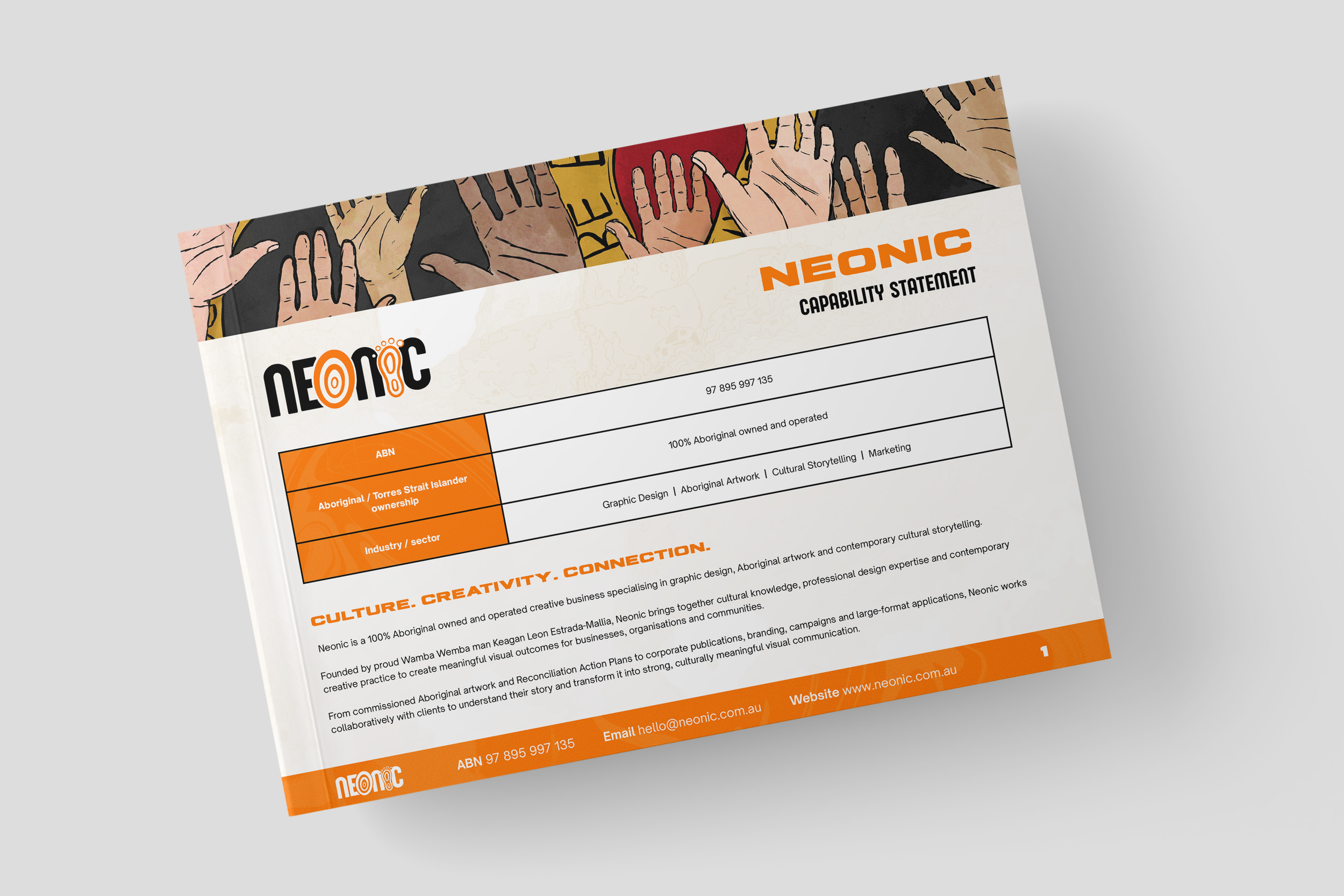
See how the template can be transformed into a professional, procurement-ready capability statement. Using the template, I’ve created a Capability Statement for my own business, Neonic. I’ve changed the colours, typeface, relevant sections, and images to match my brand.
QUICK TIPS
Keep it to 2–4 pages. Buyers and procurement teams skim — lead with what makes you the right choice.
Use plain, confident language. Avoid jargon your reader may not know.
Add your logo, and a photo of your team, work or Country if you have one you're proud to share.
Only include the Aboriginal and/or Torres Strait Islander ownership and certification details you are comfortable sharing publicly.
Save a copy as a PDF before sending, so your formatting stays intact on any device.
Review and refresh this document every 6–12 months, or whenever your services, certifications or contacts change.
USE THE CANVA TEMPLATE
Open the editable Kinaway template in Canva and customise it with your business information, branding, imagery, and experience.